

Publishing & Validation Pipeline
The JLT platform uses an automated publishing pipeline to ensure that all content (docs, blog posts, project pages, and resources) is validated, reproducible, and deployed in a consistent and reliable way.
Pipeline Overview
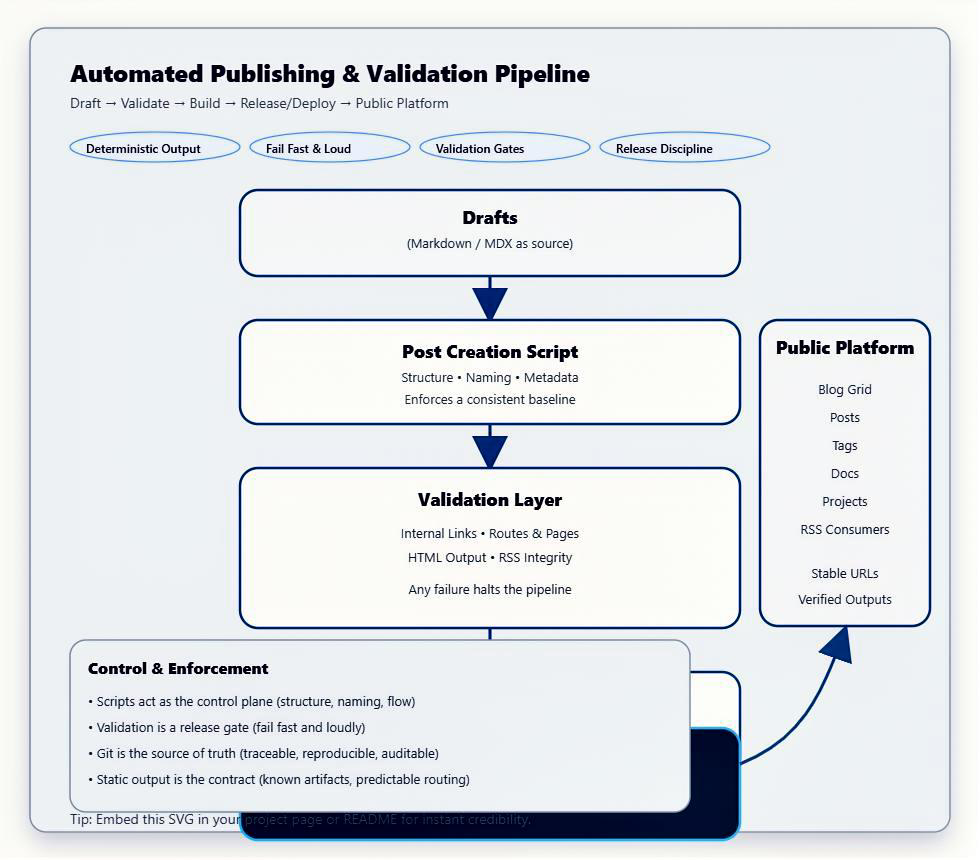
All content flows through a controlled pipeline before reaching the public platform. This pipeline enforces structure, validates output, and ensures that releases are stable, traceable, and reproducible.
Pipeline Stages
- Drafts: Content is written in Markdown or MDX and stored as source files.
- Post Creation Script: Enforces structure, naming conventions, and metadata so all content follows a consistent baseline.
- Validation Layer: Checks internal links, routes, HTML output, and RSS integrity. Any validation failure stops the pipeline.
- Release / Deploy: Verified content is built and deployed to the public platform (docs, blog, projects, and resources).
Control & Enforcement
- Scripts act as the control plane for structure, naming, and publishing flow.
- Validation acts as a release gate — fail fast and loudly if something is wrong.
- Git is the source of truth — traceable, reproducible, and auditable.
- Static output is the contract — predictable artifacts and stable routing.
Why This Matters
The publishing pipeline is part of the platform delivery system. It ensures that documentation, blog posts, and platform resources are delivered with the same discipline as software releases: validated, versioned, and reproducible.
This approach turns content publishing into a controlled engineering workflow rather than a manual process.